Flame-Retardant vs Flame-Resistant: Key Differences

What Does “Flame-Resistant” Mean? 

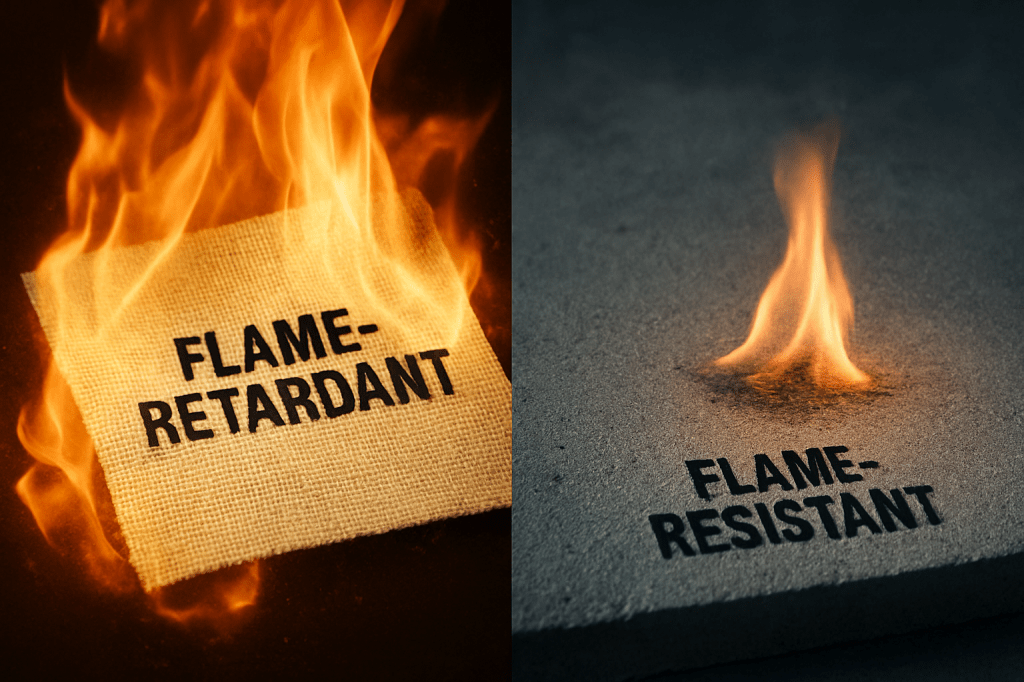
Flame-resistant is a characteristic to resist ignition and to self-extinguish if ignited.

What Does “Flame-Retardant” Mean? 

Flame retardants are activated by the presence of an ignition  source and are intended to prevent or slow the further development of ignition by a variety of different physical and chemical methods.

What Is the Difference Between Flame-Resistant and Flame-Retardant? 

Flame-resistant naturally resist burning when exposed to flames, extinguishing any flame that strikes them. 

Flame retardant is a substance that is used to slow down or stop the spread of fire or reduce its intensity.

What is “Flame-Retardant (FR) Treatment”  ? 

Flame retardant treatment can be classified as either flame retardant or flame resistant depending on the result against an open flame. Since all FR standards are intended to test both types, flame retardant and flame resistant, these two terms are used interchangeably and may share the acronym “FR”. Flame resistant treatments will likely achieve a higher rating or classification than flame retardant treatments when applying the same test standard.

Top Welding Blankets in South Africa: FiremanBrand™ Review

The FiremanBrand™ Welding Blanket has been trusted in the South African welding industry since 2004. Our welding/fire blanket is a needle-punched product that does not burn, melt, soften or drip, is 550gsm, 4mm thick and is made up of 100% Oxidized / Stabilized Polyacrylonitrile Fibre.  It is a light weight and flexible blanket which is used as a welding blanket or as an emergency fire blanket to protect sensitive areas from grinding sparks, welding splatter, throw over open fires and protect human life in fire emergencies.

Sapphire Flame Retardant

We offer flame retardant treatments and certification with our Proudly South African flame retardant, to satisfy the requirements for exhibitions, schools, weddings, hotels, theatres, indoor and outdoor stages, insurance compliance for fire regulations according to SANS 10400 part T for new and existing buildings and SANS 1036 for Health and Safety at events for stage and window curtains, polyester printed banners, polyester and velour draping, carpets, foam mattresses, sofas, tablecloth and napkins, raffia, hay bales, thatch in dry areas, wooden stage and movie sets